Airport 2040
Personal shuttles handle check-in, identity checks and baggage on the way to the plane
The airport is currently the weak link in the air transport industry.

- Team
- 8 master students
- Disciplines
- Aeronautics and Astronautics · IT Systems Engineering · Industrial Design · Public Administration · Social Design · Software Engineering
What happened, step by step.
Challenge
Airports are the weak link in air transport, designed for flow and resources rather than passengers. EADS asked for a friendly airport for 2040 that suits all travellers and stays viable for every stakeholder.
What they built
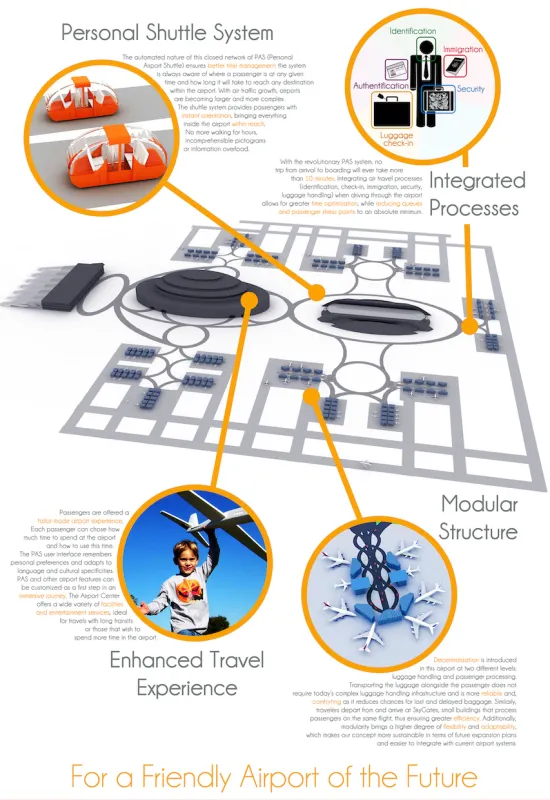
Airport 2040 combines transport, authentication, immigration and baggage handling. Personal shuttles carry families, business travellers, backpackers and impaired passengers from arrival to take-off, with check-in and baggage handled on board. A central airport centre links to decentralised skygates.
Full project text
The team’s original texts from the project page.
How would airports in the year 2040 would be like? We have the solution!
Challenge
Airports are among the largest and most complex systems in modern society. They are an assemblage of people, processes, technology, government agencies, private companies, vehicles and information. Nevertheless, the airport is currently the weak link in the air transport industry. Airport design has often been driven and concerned with flow optimization and resources allocation, at the expense of the passenger comfort and convenience. Besides, the impact of rules and regulations on the economic sustainability of air transport as well as the perverse effects of local optimization conducted by airlines, airports, etc. have demonstrated the need for a global approach that goes beyond single stakeholder positions.
The Friendly Airport of the Future has to focus on being friendly to the passenger, while remaining sustainable and addressing all types of user groups, despite their age, their flying frequency, their culture or their socio-economic status. The challenge towards 2040 is to make sure that this new airport vision becomes a shared objective for all stakeholders, meaning that it should be economically viable, technically feasible, while still humanly desirable.
Solution
The eight students from France and Germany developed an airport concept, which combines all of the major processes in airports like passenger transportation, authentication, immigration and baggage handling, creating an airport layout for the future. Since all different kinds of people travel, the students focussed very much on a smart and pleasant transportation system throughout the whole airport. Personal airport shuttles enables families, weekend travellers, business travellers, backpackers and even impaired people to process conveniently from arrival to take-off. All kinds of authentication, as well as check-in and baggage handling are done within the air shuttles. Therefore baggage issues are greatly reduced, since it stays with the passenger as long as possible. The interplay of a central airport center together with decentralized skygates and short roads in between them round off the final solution.
At the end, the students named their final design “Airport 2040 - fast, smart, intuitive”.
Watch the team’s pitch.
Opens in a new tab – no third-party player is embedded on this page.
From the field to the prototype.
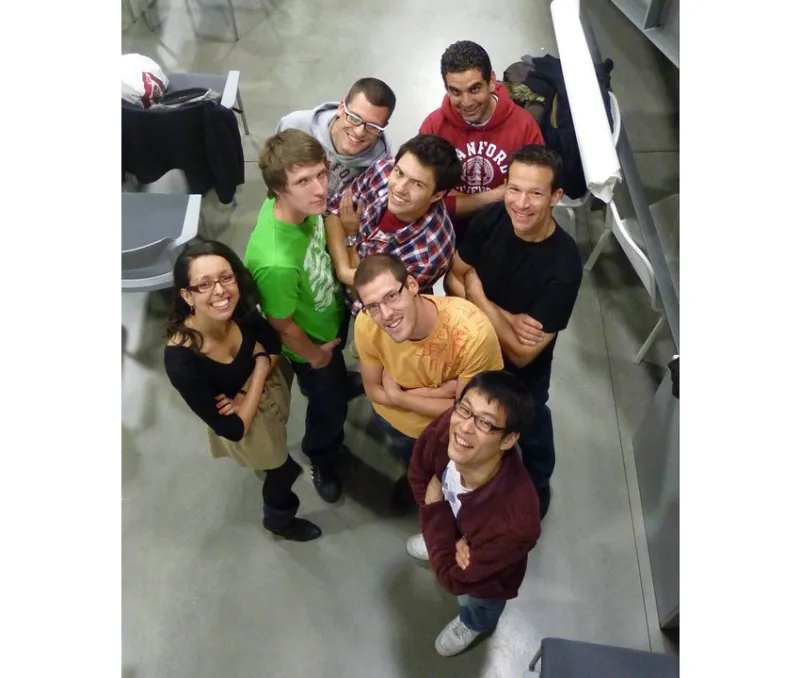
Who built it.

Sarah Fathallah
Social Designer

Paul Mauduit
Industrial Designer

Khaled Sellami
Public Administration International Development
Tomoya Yamamoto
Aeronautics & Astronautics

Stefan Hampel
IT Systems Engineering

Michael Karsch
IT Systems Engineering

Keven Richly
Software Engineering