COEX
Operators and cobots signal position and intent to each other in both directions
Increasing Human-Robot Collaboration Beyond sensors
- Team
- 8 master students
- Universities
- University of Bologna · Almacube
- Disciplines
- Anthropology · Biomedical Engineering · Computer Vision · Mechanical Engineering · Service Design
What happened, step by step.
Challenge
IMA asked the team to rethink human-robot collaboration: improve efficiency without compromising safety, and redesign how operators and collaborative robots (cobots) communicate.
What they built
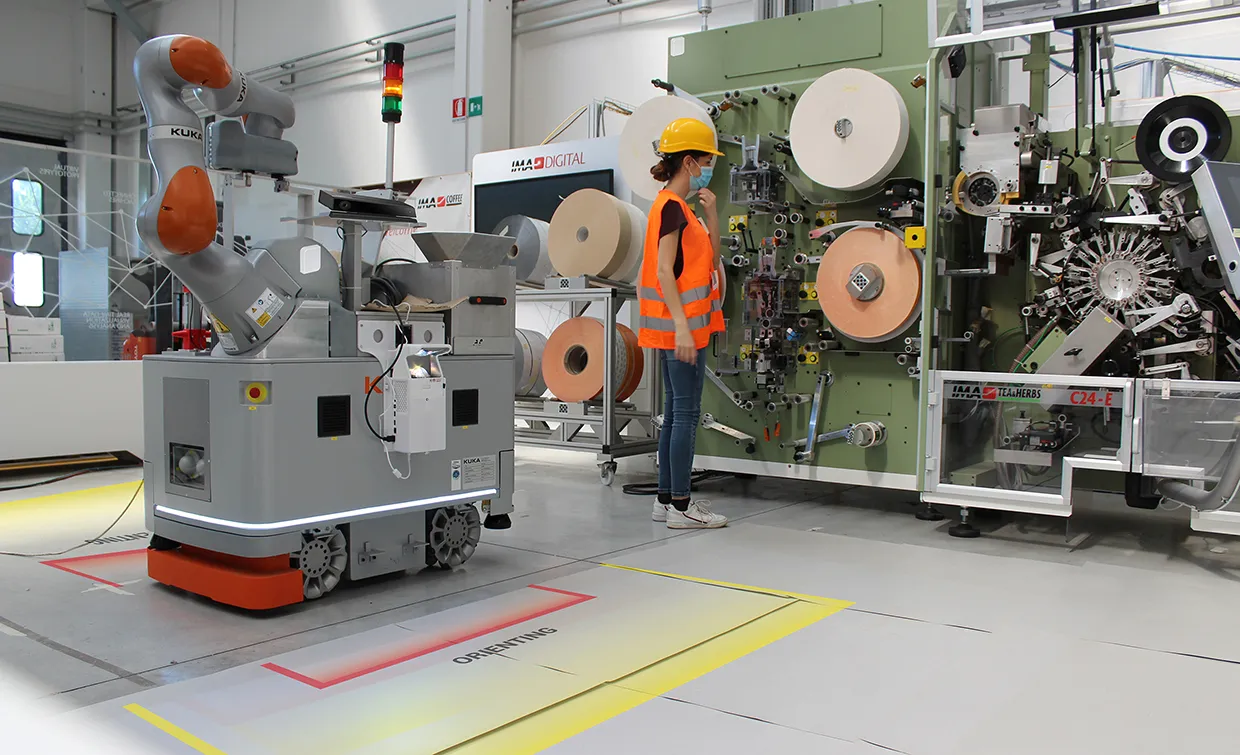
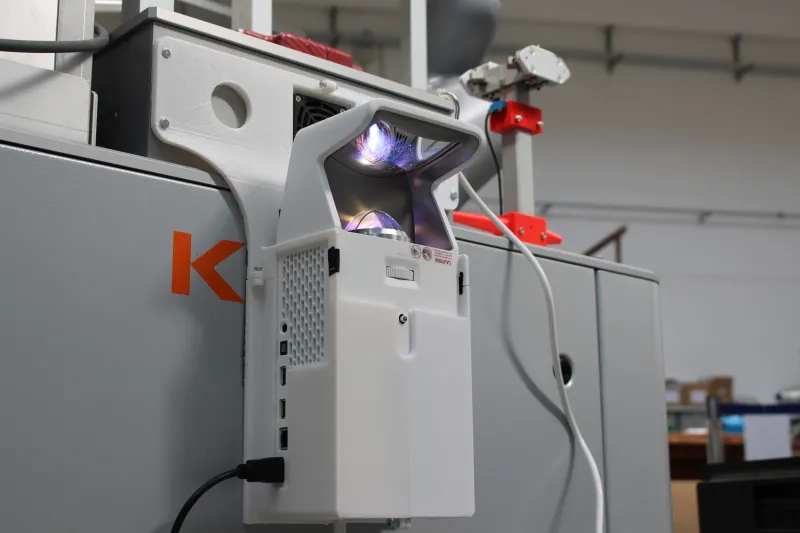
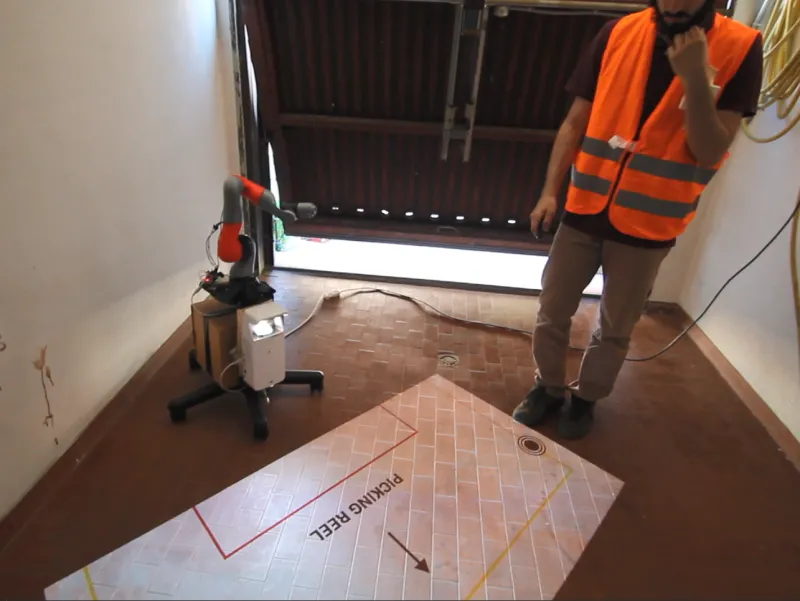
COEX is a five-part system. A Kinect camera detects the operator's joints, ultra-wideband localisation tracks positions within a few centimetres, floor projectors show danger zones and tasks, and a wearable vibrates when the robot gets close. A cloud network links everything.
Impact
Operators know they have been detected and what the cobot will do next, so they feel more comfortable and can work alongside it more efficiently.
Full project text
The team’s original texts from the project page.
A bi-directional communicational system which enables a safe, efficient and comfortable collaboration between humans and robots by creating a new common language of interaction.
Challenge
Re-think human-robot collaboration to improve efficiency without compromising safety and redesign communication dynamics and tools between cobots (collaborative robots) and humans to improve safety levels and work conditions.
Solution
COEX is a bidirectional communication system which introduces the foundation for a proper collaboration between humans and industrial robots creating a new common language. Communication is indeed fundamental to enable collaborative processes, because it establishes the relational codes that allow the two parts of a relationship to understand each other and to do something together efficiently. This new communication dynamic helps the operator and the cobot (collaborative robot) understand each other without necessarily making one adaptable to the other, but giving them a common language of interaction, thus mutual comprehension.
Impact
COEX is a modular system made by different components, which are needed to have a clear overview of the cobot’s and the operator’s position, and to make them aware of what is happening in the plant.
Thanks to COEX the operators are able to work efficiently without stepping on the cobot, and viceversa. COEX makes the operators aware that they have been detected (so they are safe) and it informs them about the cobot’s movements. Thanks to that they can feel more comfortable around it. With a proper collaboration, thanks to a proper communication, the operators and the cobot can finally
collaborate as two colleagues, working faster and better.
Watch the team’s pitch.
Opens in a new tab – no third-party player is embedded on this page.
From the field to the prototype.
Who built it.

Isabella Ciampi
Anthropology

Daniele Magnani
Mechanical Engineering

Lucia Monti
Service Design

Lorenzo Tartarini
Biomedical Engineering

Mingqi Shuai
Mechanical Engineering

Perry Cai
Mechanical Engineering

Masoud Charkhabi
Computer Vision

Christina Li
Computer Vision