Kintsugi
An automated station distributes food portions, goods and information after earthquakes
Creating System That Supports House Refugees after Disasters.
- Key fact
- 30 kmsome house refugees walk to an open shop
- Team
- 6 master students
What happened, step by step.
Challenge
After earthquakes in Italy and Japan, people who stay in their damaged homes, so-called house refugees, cannot reach evacuation-centre supplies. Yanmar asked for a way to bring them goods, information and community.
What the team learned
Evacuation spots refuse goods to people living at home. Volunteers want to help but cannot tell where house refugees are, so they walk from house to house.
What they built
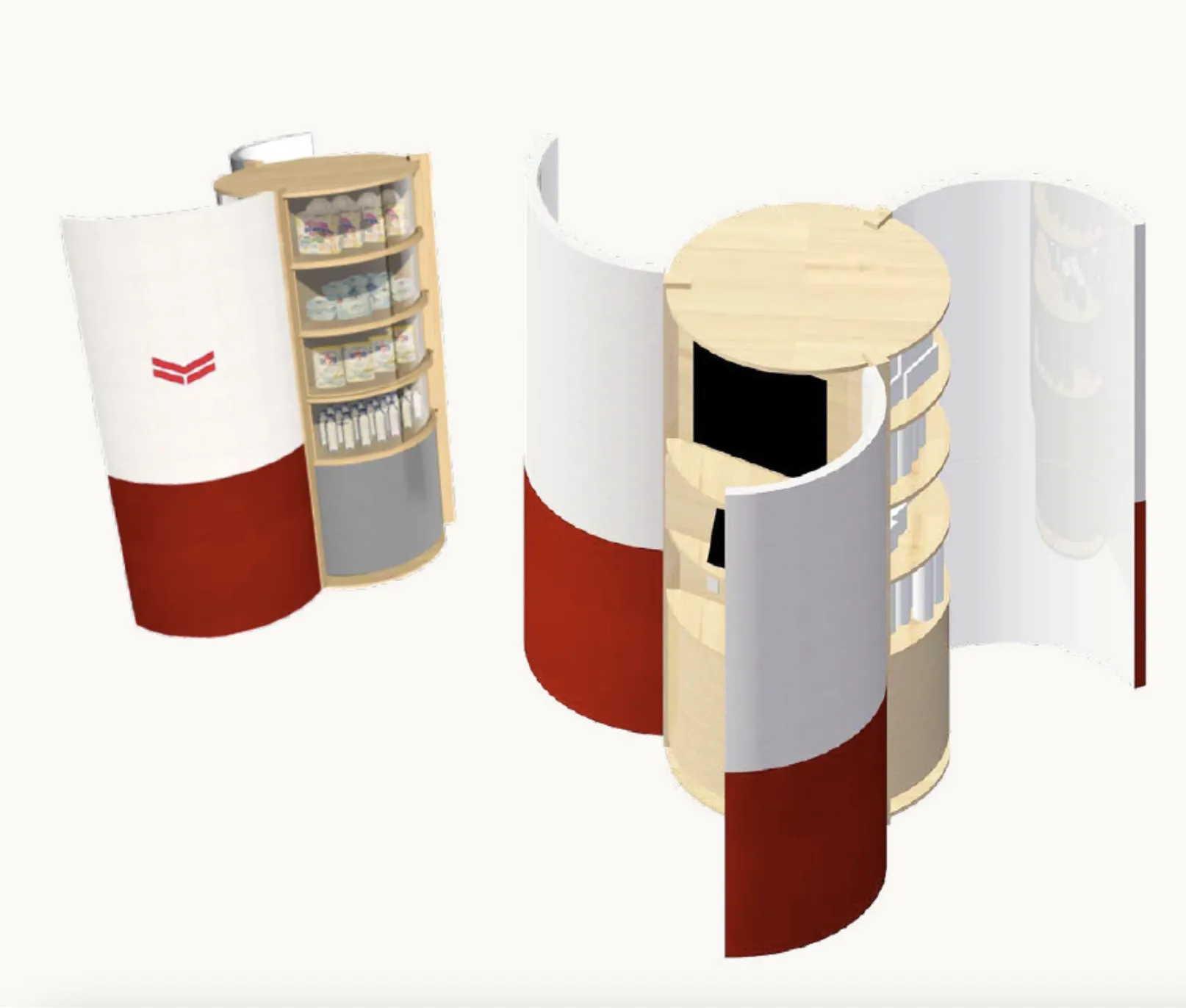
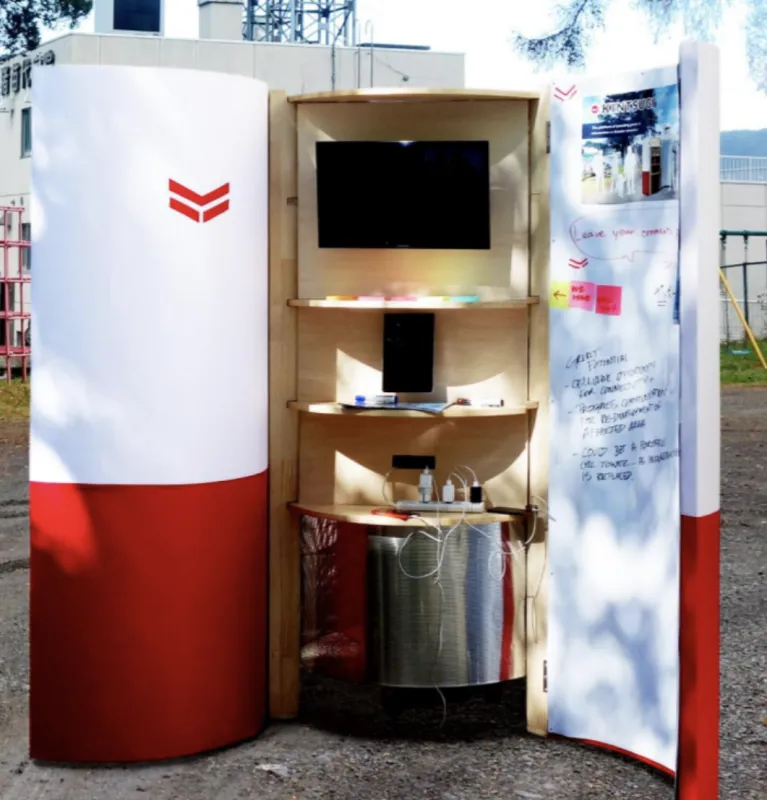
Kintsugi is a foldable, three-zone storage shelf powered by a gas generator. A display shares disaster information, an automatic zone hands out fixed food portions, and a staffed zone gives out supplies. Families pre-register on an iPad so volunteers can adjust goods.
Impact
Projected: the shelf would arrive about three days after an earthquake with Yanmar construction machinery, then be assembled and stocked by volunteers.
Full project text
The team’s original texts from the project page.
The team developed the Kintsugi, a three-part automated storage system to help support disaster relief victims.
Challenge
Both Italy and Japan have suffered greatly from earthquakes and have developed their own methods of relief. However, there is still room for improvement and innovation. In doing research, the team found that people who stay in their homes after an earthquake suffer both physically and mentally. The goal was to find ways to help and support these House Refugees by supplying them with goods, information, and community.
Solution
The team came up with Kintsugi, a three-part automated storage system to help support disaster relief victims.
Information Zone: The first need is a lack in giving and receiving information. To create a communication channel there is a display where information is broadcast to volunteers.
Auto Food Distribution Zone: The aim of this part is to distribute automatically to people what they need, in particular food. In doing so, the system has to provide a fixed amount of food per person, and, at the same time, it has to control whether someone is trying to steal a greater quantity or not.
Handed Distribution Zone: In the handed distribution zone. house refugees can get supplies, for example, mothers can get much needed baby supplies. Hand distribution is important because it gives a reason for people to talk and connect, forming a stronger community.
Watch the team’s pitch.
Opens in a new tab – no third-party player is embedded on this page.
From the field to the prototype.
Who built it.

Marco Bonari

Rossella Bersani

Andrea Monti