PowerPilot
Machine learning schedules industrial cooling by energy price, emissions or both
Energy Management. Intelligent, Easy & Sustainable

- Key fact
- Up to 20 %Projected electricity cost savings
- Team
- 8 master students
- Disciplines
- Business Administration · Data Engineering · Digital Health · Industrial Engineering · Information Systems
What happened, step by step.
Challenge
Industrial heating and cooling cause around 10% of industry's carbon emissions. GEA asked for a cloud-based, data-driven way to cut the energy use and emissions of its compressors and chillers.
What the team learned
Cooling operators lack visibility and planning capacity for their energy use. Machine sensors exist, but the data is not put to work, and customers must trust a supplier with it.
What they built
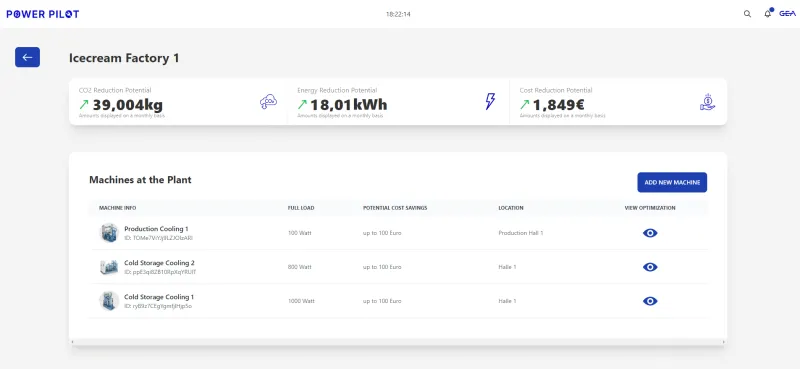
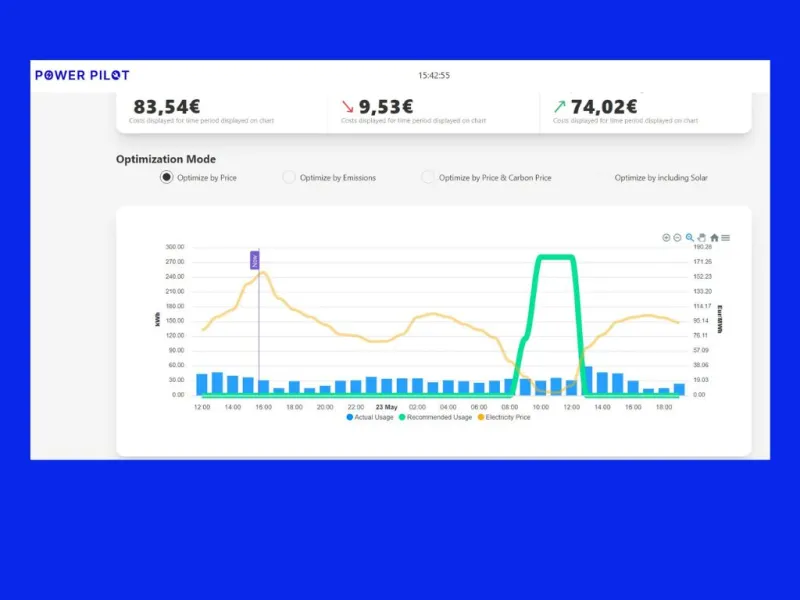
A web platform that collects energy data from cooling machines across plants and shows current and historical cost and CO2, including on-site solar. An LSTM forecast, plus price and grid-mix forecasts, optimises machine operation for cost, emissions or both.
How it evolved
- Step 1Cool-Dash showed machine status, energy use and forecasts; monitoring and displaying energy use mattered most.
- Step 2EcoFreeze and Cool Operator added real-time monitoring, predictive usage and what-if simulation.
- Step 3Functional prototype Nordstorm combined usage prediction, energy-mix analysis and emission optimisation, then became PowerPilot.
Results
- 30 early interviews plus 18 prototype-testing interviews with cooling managers, scientists, sustainability officers and operators.
- Projectedelectricity costs down by up to 20%, or carbon emissions down by up to 10%.
Impact
The team proposes a value-based model that takes about 10% of customers' energy savings, to be refined with first pilot customers, and hopes to keep working with GEA.
Full project text
The team’s original texts from the project page.
An energy management tool that reduces carbon emissions and costs of industrial solutions.
Challenge
Mitigating climate change requires a focus on reducing the carbon footprint of industrial heating and cooling solutions. These processes are notorious for their high energy intensity, resulting in significant CO2 emissions. Notably, cooling and heating solutions contribute to 10% of the industry's carbon emissions. GEA, a global leader in the field, recognized the urgency to address this issue and sought a data-driven solution to optimize energy consumption, enhance efficiency, and decrease carbon emissions in their machinery. GEA's heating and cooling solutions, including compressors and chillers, find applications in diverse sectors such as food & beverage, oil & gas, and pharmaceuticals, amplifying the importance of their efforts.
Solution
Our innovative energy management tool, PowerPilot, revolutionizes the utilization of cooling solutions. By leveraging historical data, PowerPilot predicts via machine learning the future cooling requirements of machines. Users have the flexibility to optimize cooling machine usage based on energy price, carbon emissions, or a combination of both. Furthermore, PowerPilot integrates the potential of solar panels installed at the user's facility into the optimization process. This comprehensive platform empowers customers to optimize cooling solutions within individual plants and across multiple facilities, leading to substantial reductions in carbon emissions, improved efficiency, and cost savings.
Impact
PowerPilot, our energy management tool, has a profound impact on both the users and GEA. For users, PowerPilot enables optimized utilization of cooling solutions, leveraging predictive capabilities and allowing users to make informed decisions based on energy price, carbon emissions, and other factors. This results in reduced operational costs, enhanced energy efficiency, and decreased carbon emissions, aligning with sustainability goals. For GEA, PowerPilot offers a competitive edge by providing a comprehensive platform that addresses customer needs for carbon footprint reduction, increased efficiency, and cost savings.
Watch the team’s pitch.
Opens in a new tab – no third-party player is embedded on this page.
From the field to the prototype.
Who built it.

Melanie Krause-Rebscher
Business Administration

Matthias Schneider
Data Engineering

Mostafa Elgayar
Digital Health

Quirin Ertz
Data Engineering

Marieke Hoell
Industrial Engineering and Management

Bjarne Louis
Information Systems

Nils Ness
Industrial Engineering and Management

Moritz Diener
Information Systems