waytoB
Picture-based turn-by-turn directions on a smartwatch help people with intellectual disabilities travel alone
Independent Navigation for Everyone
- Team
- 2 master students
- Universities
- Trinity College Dublin
- Disciplines
- Engineering Management · Production Engineering
What happened, step by step.
Challenge
People with intellectual disabilities often cannot find their way without help, so every trip needs supervision. Existing navigation apps are too complex for them.
What the team learned
Navigation platforms leave out what matters to these users, such as where it is safe to cross, which side of the road a destination is on, and an intuitive map orientation.
What they built
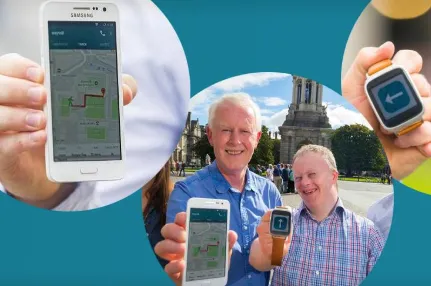
A smartwatch gives turn-by-turn directions in a simple graphical language, linked with public transport. On a smartphone, a carer sets destinations, follows progress, heart rate and battery, and gets activity reports. Both sides have a panic button.
Impact
Teaching a route used to take carers months; waytoB shortens this. The project continued as the startup WayToB and is described as multi-award-winning.
Full project text
The team’s original texts from the project page.
waytoB is a multi-award winning integrated smartphone and smartwatch solution to enable people with intellectual disabilities navigate independently.
Challenge
Getting from A to B is something that is taken for granted by most. This, however, can be a major problem for people with intellectual disabilities who can not find their way around without assistance.
This prevents these individuals from travelling independently and means that they require supervision every time they need to go somewhere. Current navigation tools are not appropriate for them due to their complicated interfaces. The challenge for the team was to make navigation simple for all.
Solution
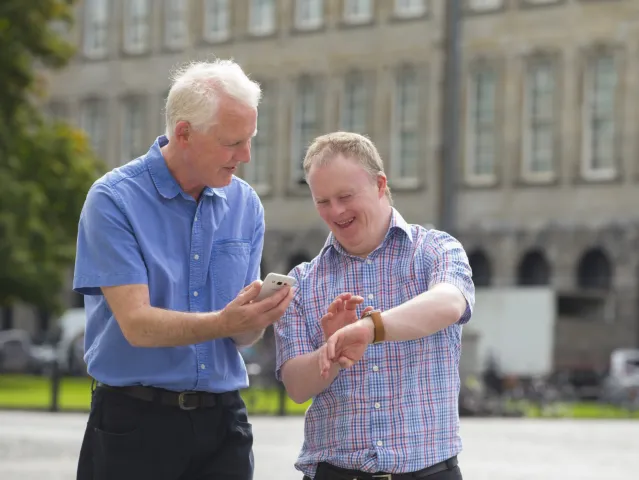
An intuitive graphical language is used to give turn-by-turn directions to the user through a smart-watch, while the partner (e.g. carer) can set the destinations, monitor progress and communicate, if required, with the user.
It gives peace of mind to the carer by giving them live reports on the users heart rate, position and battery usage. Activity reports are used to update the carer on key performance measures.
The use of intuitive directions makes it simple for the user to complete their journeys. Walking instructions are also integrated with public transport and a panic button can be used by both parties in the case of an emergency.
Impact
It was found that other navigation platforms don’t include important information, such as where it is safe to cross a road, what side of the road a destination is and the orientation of the map is not very intuitive. waytoB, however, allows people to go to new places independently. The instructions are based on real time location and orientation data, which makes the navigating experience as easy and stress free as possible.
Before this, it took carers months to teach those with intellectual disabilities a route from their home to the care center. Now waytoB shortens this process, while simultaneously giving the carer peace of mind as they are updated about the users progress in real time.
Watch the team’s pitch.
Opens in a new tab – no third-party player is embedded on this page.
From the field to the prototype.
Who built it.

Robbie Fryers
Engineering with Management

Talita Holzer Saad
Production Engineering