Agora
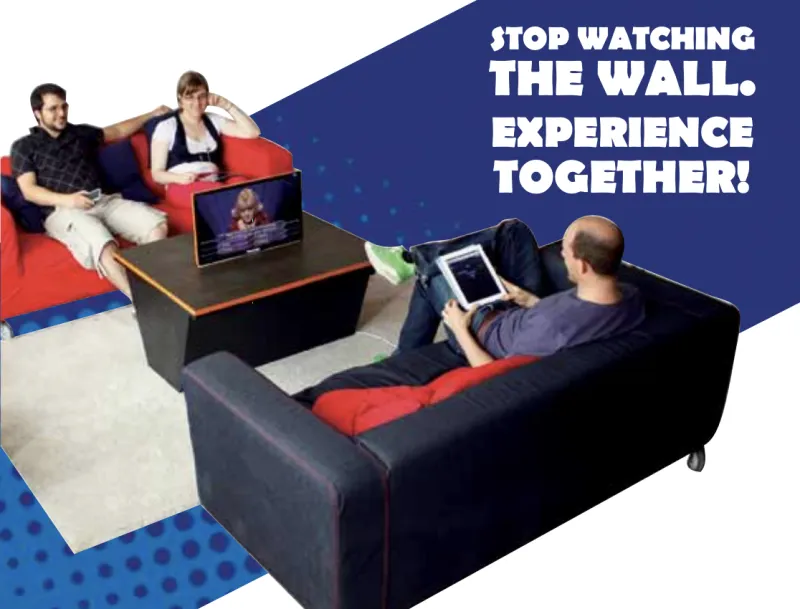
Two back-to-back screens on the coffee table let viewers face each other
Creating an interactive TV experience.

- Key fact
- 65 %of viewers did something else while watching
- Team
- 7 master students
- Disciplines
- Automotive Design · Business · Computer Science · Engineering · Industrial Engineering
What happened, step by step.
Challenge
Panasonic asked how to improve TV use while keeping people interacting with each other. Complex remotes, interfaces and content selection were degrading the viewing experience.
What the team learned
TV viewing time has not dropped, and households still gather in front of it. But wall-mounted sets line viewers up side by side, while homes without a TV gather around a coffee table.
What they built
AGORA places two 23-inch screens back to back on the coffee table, showing the same content. Viewers see and talk to each other over the frame without missing the action. Each screen can also show a different angle, for example of a concert.
Results
- Testers quickly appreciated the setup and felt a stronger connection with each other.
Impact
The concept lets Panasonic compete beyond the bigger-is-better race, with a TV that has value in itself for a more social living room.
Full project text
The team’s original texts from the project page.
All TV viewers can see at the same time and interact with each other over the top of the frame and still not miss the action.
Challenge
How could we improve the use of TV, while getting people to continue to interact with each other? Manufacturers advertise an idealized picture of happy viewers sitting on a couch being totally absorbed looking at the screen. During the students' need-finding, research and observation, they found that 65% of viewers were doing something else while watching and that over complex remotes, interfaces, and content selection processes were degrading the quality of the users’ experience.
Solution
Yet despite all this and the increasing use of other devices to access content, TV consumption time in households has not dropped and has even slightly gone up. They observed people still meet in front of the TV at home and therefore realized that there is a need for a collective entertainment experience. Despite all of its problems, today’s TV is still the most natural device to fulfill this need as it is intrinsically a shared device, as opposed to tablets, laptops or smartphones which belong to a single individual.
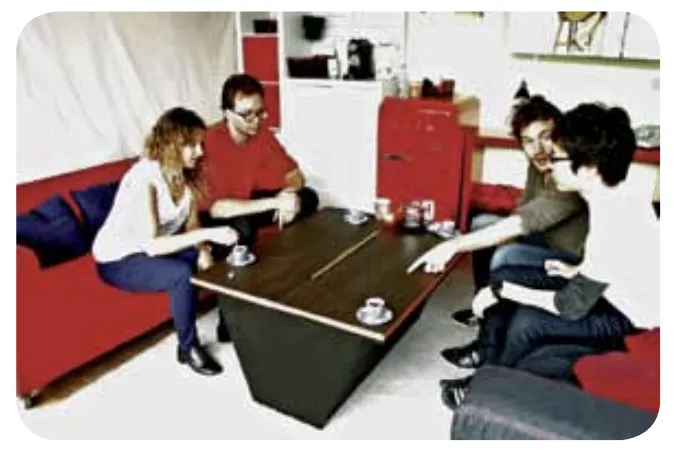
However, one of the great issues impeding TV sets’ expected “socialness” was the fact that in the current living room setups in Europe, TV sets were placed against a wall, with the viewers all lined up side by side facing it. Aiming for natural integration into users’ living rooms, they looked at households where there was no TV. There was always a central gathering place, usually seats and couches surrounding a coffee table. This is where we decided to place the TV. Indeed, this will be technologically possible because of the increasing use of wireless data exchange between devices.
Impact
By putting two 23-inch screens, displaying the same content, back to back on the table, all viewers could at the same time see and interact with each other over the top of the frame and still not miss the action. Additionally, this provided a much more natural living room furniture set up. From testing, this setup was quickly appreciated, gave a feeling of a stronger human connection with one another, and a much higher quality entertainment experience. This system is called AGORA.
It allows Panasonic to challenge the way the TV industry has been competing during the last decades, notably by withdrawing from the “bigger is better” philosophy and also by reducing the relative importance of the content displayed on the overall viewer experience, by giving the device a value in and of itself compared to other TV sets. It also opens a door towards new content possibilities as, while still showing the same content on each screen, it also enables to have 2 different points of view, with, for example, two different viewing angles of a concert or a sport’s match. All this combines to giving Panasonic the opportunity to define a new direction in the TV market, becoming the leader towards a more social living room experience.
From the field to the prototype.
Who built it.

Helene Dieumegard
Industrial engineering

Benjamin Delaoutre
Automotive designer

Othonas Papiliou
Business

Emmanuel Dissoubray
Engineering

Lars Butzmann
Computer Science

Cornelius Illi
Computer Science

Caroline Fetzer
Computer Science