ARK-E
A 3D-printed micro-mobility vehicle made from recyclable fluorene cellulose fibre
Creation and development of one future-oriented micro-mobility based on the fluorene cellulose fiber (FLCF)

- Key fact
- 2.5 %FLCF share in the first prototype compound
- Team
- 7 master students
- Disciplines
- Design · Product Design · Graphic Design · Materials Engineering · Engineering
What happened, step by step.
Challenge
Osaka Gas Chemicals developed fluorene cellulose fibre (FLCF), a highly recyclable plant-based material. The team had to find future applications and a way to turn the material into a product.
What the team learned
Micro-mobility is rarely used in Japan because of regulation and a traditional society, so tourists come first, then daring young Japanese. FLCF itself is not yet stable enough for the mass market.
What they built
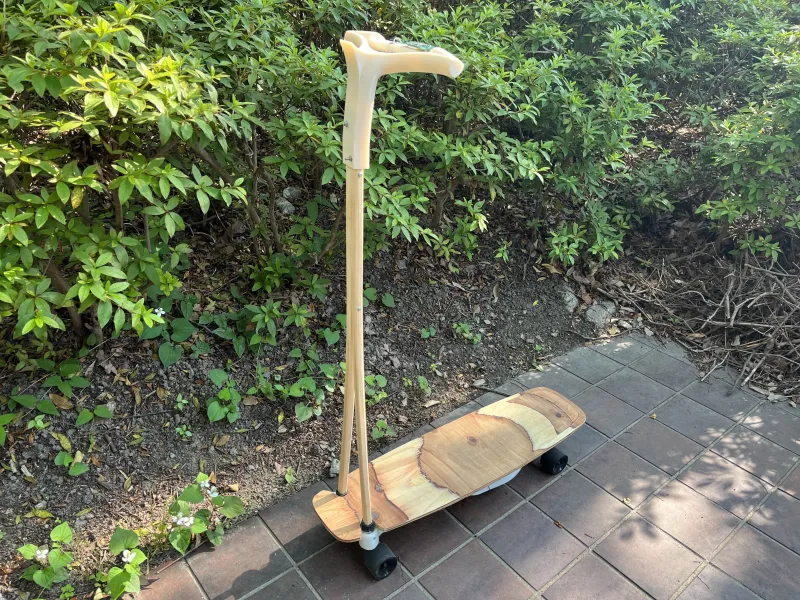
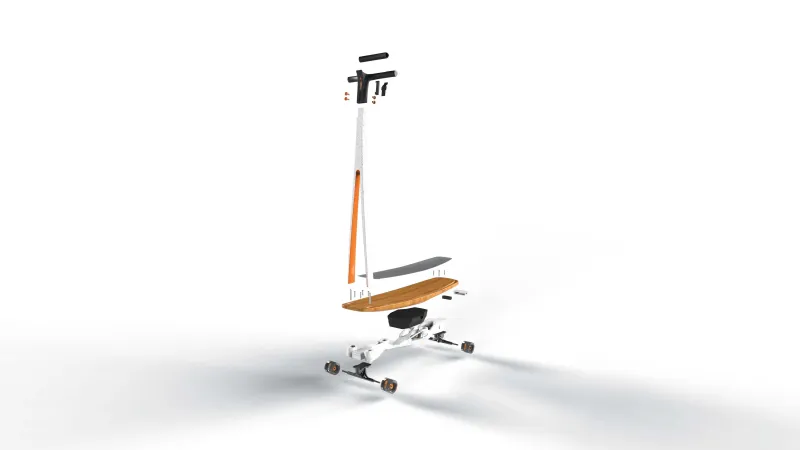
Ark-e is an electric scooter-skateboard hybrid for Japan. Handlebars, stem and body use FLCF with PLA, making it light and strong. The body is a 3D-printed generative design, and riders lean to turn it like a skateboard.
How it evolved
- Step 1First iterations used a compound of 2.5 % FLCF and PLA, shaped by early tests with tourists in Japan.
- Step 2Plan to 2030: more FLCF content, eventually fully biodegradable, with a foldable, detachable stem that turns it into a skateboard.
Impact
The team offers Osaka Gas Chemicals a route to commercialise FLCF, starting in the Japanese market, with a roadmap towards more FLCF content by 2030.
Full project text
The team’s original texts from the project page.
ARK-E is a future-proof Micro-Mobility based on highly recyclable FLCF material. It has many advantages such as easy riding, safety, and good intelligence. The main thing is based on FLCF material, it will have good recyclability, which makes ARK-E can be quickly repaired or recycled, etc.
For ARK-E, we pioneered the use of FLCF filament and 3D printing technology to produce, which are also the highlights of the product.
ARK-E will be marketed in the Japanese market first, which will be promoted from foreign tourists and the young generation of Japanese to all Japanese consumers.
Challenge
Fluorene cellulose fiber (FLCF), developed by Osaka Gas Chemicals, is a cellulose material extracted and modified from plants to be highly recyclable.
Our goal is the commercialization and marketization of this material for future products.
There are two main challenges for us, one is how to find suitable application scenarios for this material, and the other is how to make good use of FLCF with existing technology, or what are the ways to turn FLCF from a mere material into a product.
Solution
For the above problems, we conducted a lot of need-finding and benchmarking in the early stage, and we also conducted a lot of brainstorming, based on our summary of the advantages of FLCF as a material, we narrowed our scope a little bit and finally settled on micro-mobility.
Our focus field is micro-mobility, which will have lightweight, highly recyclable, ease of travel, and some future-oriented advantages. This micro-mobility will bring more safety, convenience, and fun to people's travel life, and aims to become one of the common modes of travel in the future.
Impact
For our target users, the emergence of arke brings them a new travel experience with greater safety and security and more efficient travel. Especially when traveling, arke can bring more fun to their trip. At the same time, when using arke made of FLCF, they are also doing their own contribution to the energy-saving and emission reduction of the Earth.
For OGC, we bring a viable FLCF commercialization and marketing solution that is not only for the current market but also for the future, which is more in line with the values and business plan of OGC as a material company.
Watch the team’s pitch.
Opens in a new tab – no third-party player is embedded on this page.
From the field to the prototype.
Who built it.

Bisheng Wu
Material engineer

Kagari Miyamoto
Design

Olivia Zhou
Product Design

Tamaki Hamato
Engineering

Ariella Vanya
Graphic designer

Ben Wood
Product Design

Orin Giesbers
Product Design