SPOD Connect
Small electric pods join a driver-led train along a shared spine
The future of sustainable urban mobility
- Key fact
- 90 %Projectedless CO2 than a private diesel car
- Team
- 7 master students
- Universities
- Trinity College DublinUniversity of São Paulo
- Disciplines
- Architecture · Electrical Engineering · Electronic and Computer Engineering · Environmental Engineering · Mechanical Engineering
What happened, step by step.
Challenge
SUMMIT asked how future urban mobility can balance sustainability and convenience. 1.5 billion people still choose private cars for privacy, comfort, reliability and a sense of safety.
What they built
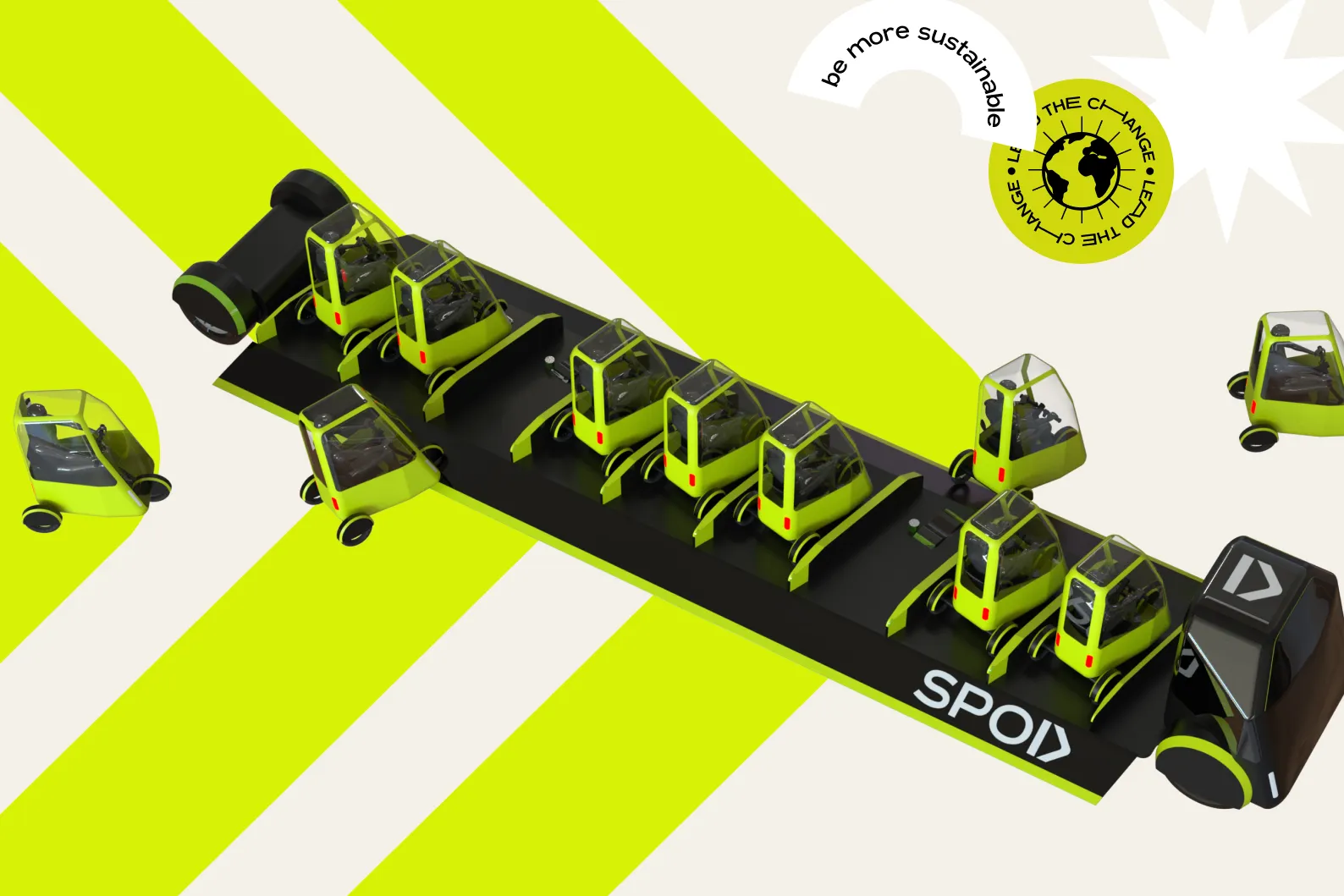
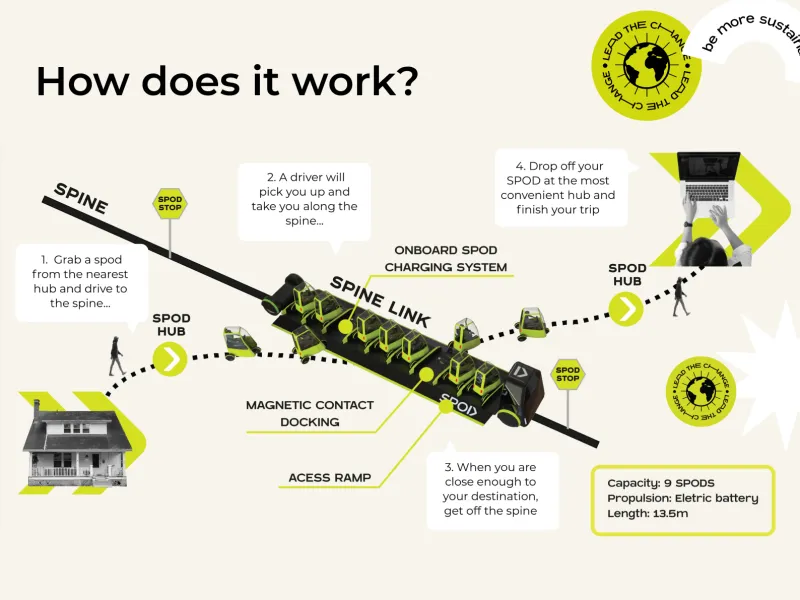
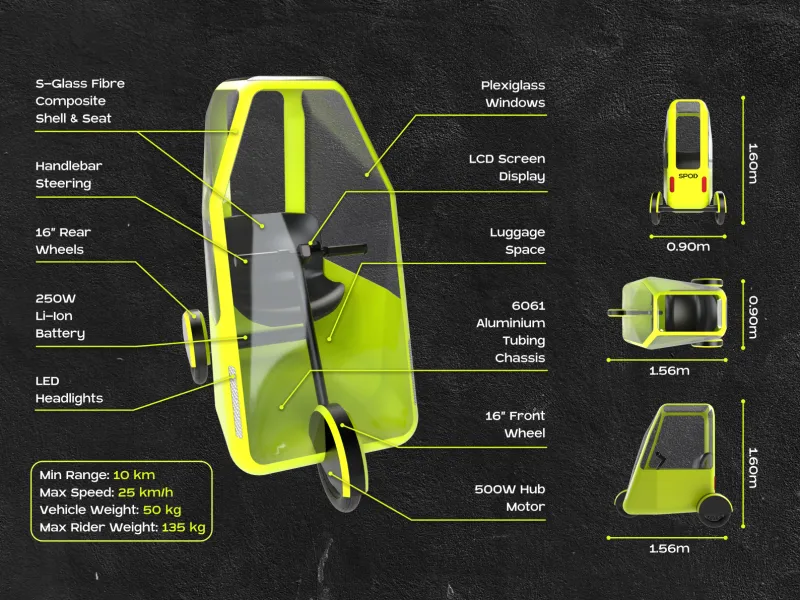
SPOD combines car comfort with public-transport efficiency. Users plan a route in the app, scan a small electric SPOD at a hub and drive it to the nearest spine. There, a driver-operated train of SPODs carries them towards their destination.
Results
- Projected90 % less CO2 than a private diesel car, including manufacturing, maintenance and charging.
- Projectedsix SPODs fit in the road space of one car.
Full project text
The team’s original texts from the project page.
A new means of transportation that combines the comfort and convenience of private transportation, with the eco-friendliness and efficiency of a public transport system.
Challenge
How might we balance the needs of sustainability and convenience in future urban mobility?
Solution
Despite private cars emitting 4.6 metric tons of carbon dioxide each year there are still 1.5 billion car users worldwide. Why? Because, in terms of convenience, private cars are the most attractive option, providing users with privacy, comfort, reliability, and a sense of safety.
The SPOD is the future of sustainable urban transport. It provides a hybrid solution, bringing you the comfort and convenience of your car, with the eco-friendliness and efficiency of a public transport system.
Impact
As SPOD Connect is a fully-electric transport system it has zero exhaust emissions. What’s more, even after considering the indirect emissions from manufacturing, maintenance, and the charging of SPODs, SPOD Connect produces 90% less CO2 emissions than a private diesel car.
As well as helping reduce transportation emissions, SPOD Connect contributes to more efficient use of road space. With 6 SPODs occupying the same space as one car, the SPOD Connect system will help ease congested roads and reduce traffic.
Finally, SPOD Connect provides commuters with a sustainable solution that doesn’t compromise the safety, comfort, and convenience of their cars.
Watch the team’s pitch.
Opens in a new tab – no third-party player is embedded on this page.
From the field to the prototype.
Who built it.

Anneliese Walsh
Electronic and Computer Engineering

Beatriz Segatti
Environmental Engineering

Finan Levingston
M.Sc. Mechanical Engineering

Giselle Jensen
Architecture and Urbanism

Jules Olier
M.Sc. Mechanical Engineering

Rachel O' Grady
Electronic and Computer Engineering

Ross Sumie
Electrical Engineering