Adavise
Cars teach drivers their assistance systems instead of hiding them in menus
Adavise be wise
- Team
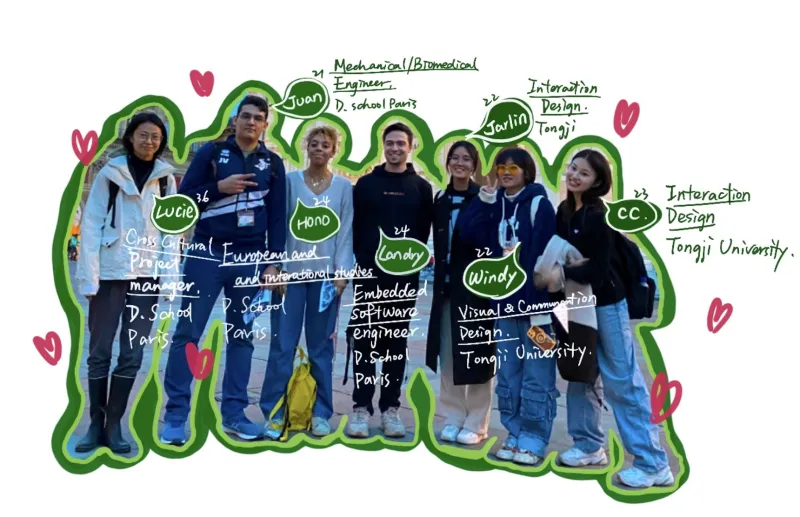
- 7 master students
- Disciplines
- Interaction Design · Communication Design · Innovation & Design · Mechanical Engineering · Software Engineering · Intercultural Studies
What happened, step by step.
Challenge
Valeo wanted drivers to use the assistance systems that can save their lives. Many French and Chinese drivers never learned them: some do not know they exist, others distrust them or cannot decode English acronyms.
What the team learned
French drivers rarely learn assistance systems from instructors or afterwards. Chinese drivers struggle to memorise functions named only by English acronyms. Drivers feel overwhelmed by the number and location of buttons.
What they built
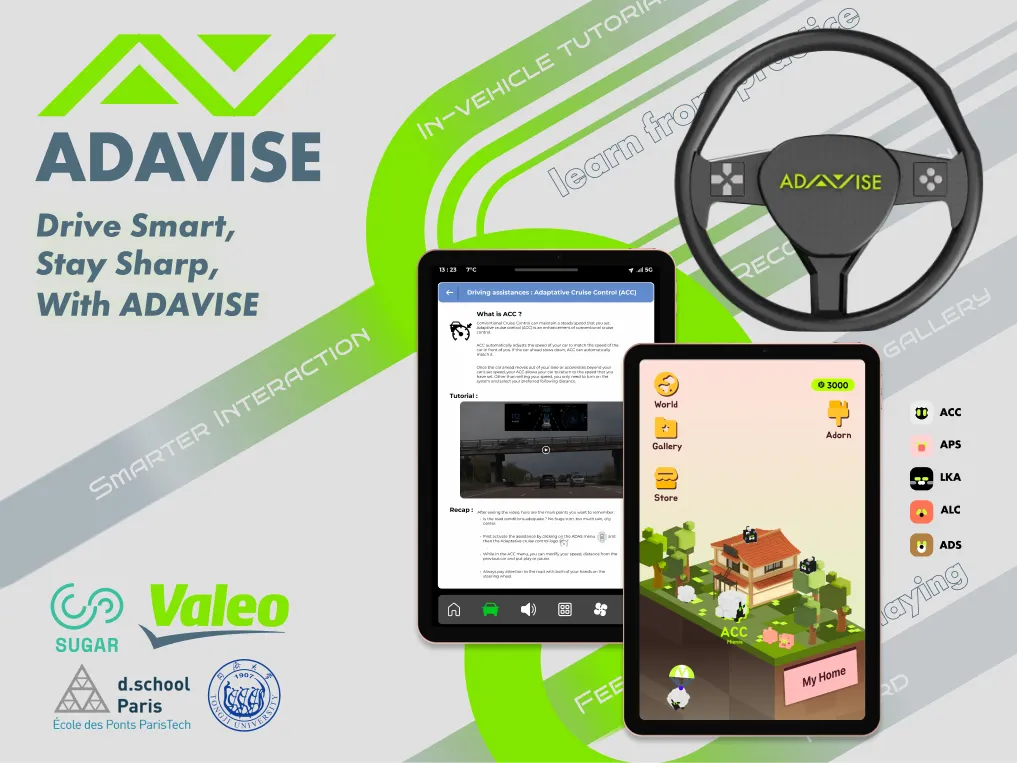
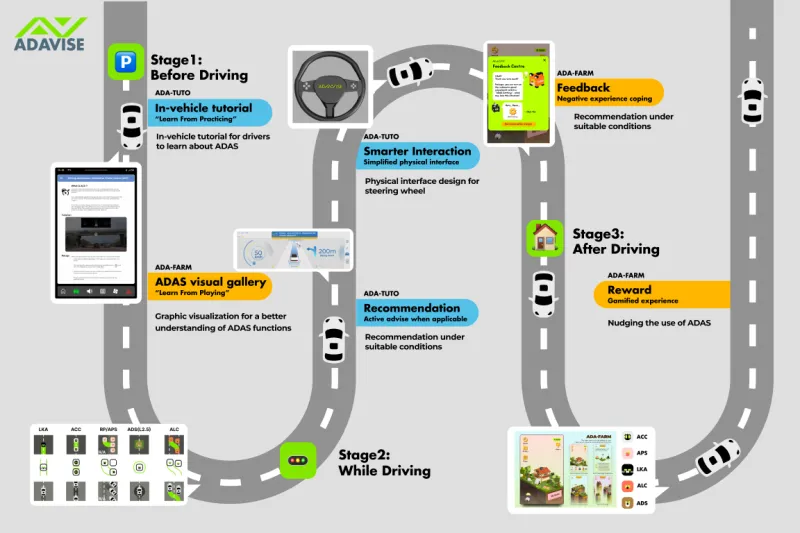
Two market versions. ADA-TUTO for France adds an in-vehicle tutorial, a simplified eight-button steering-wheel interface and recommendations. ADA-FARM for China offers a visual gallery explaining functions, a feedback centre and a gamified virtual farm with rewards and an online community.
Full project text
The team’s original texts from the project page.
The solution is presented as an immersive experience of a driving experience with the interface interaction designed by Adavise
Challenge
Most french people learned to drive cars with very functional cars and did not learn to use driving assistance while learning. They then more often than not start driving with their parents cars, and because french cars are on average 10 years old and bought second hand they do not have many driving assistance. And then we are in front of different types of people and therefore problems. The first problem is that some people don’t even know driving assistance exists. Some young drivers that have heard about driving assistance are not interested and will not go the extra mile to look and use the help. Others do not trust them because they were told horrific stories about them. And finally some people do not want to activate them because they like everything that is included in driving.
Many Gen Z drivers in the Chinese market are first- or second-generation car users within their families, often learning to drive using their family's car rather than their own. They are open to new technologies but, as only children, they also seek stronger community connections. Due to a language barrier, most Chinese people find it hard to understand and memorize different ADAS functions only through English acronyms. Additionally, driving assistance can be unusable in certain conditions and people can forget about them. Currently, ADAS serves as a more passive tool system functioning only after users choose to turn them on, and those with inadequate knowledge about ADAS tend to never use it.
Solution
We decided to revisit the interfaces entirely, the screens but also the buttons. Adding to that we strongly believe and have seen during our field research that driving assistants should be put directly in front of the users and come to them rather than the user having to look for them. Especially knowing that french users do not learn about driving assistance in driving school. And that when they have questions after driving schools they more often than not ask their parents or friends that do not use them either. That is why with our innovation cars are teaching you and advising you in addition to being simpler.
We introduced an ADAS visual gallery with graphic visualizations and text descriptions to illustrate functions clearly. Our solution also includes dashboard recommendations for using driving assistance features and a gamified reward system with an online community that encourages learning and usage, rewarding users with achievements in a virtual farm setting.
Impact
We are bringing back together the drivers and the functions that can save their lives. In the easiest way and most attractive way possible.
From the field to the prototype.
Who built it.

Juan Vidal
Mechanical and Biomedical Engineering

Honorina Diathoud
European and Intercultural Studies

Landry Marlhac
Software Engineering

Yi Bu
Innovation & Design

Jialin Yuan
Interaction Design

Xiyu Zheng
Interaction Design

Wenyi Liu
Media and Communication Design