d-kleep
A clip-together pillbox and app help patients fill their own doses
Relieve, re-live
- Key fact
- 28patients in field research
- Team
- 6 master students
- Disciplines
- Anthropology · Architecture · Biomedical Engineering · Digital Marketing · Engineering · Medicine
What happened, step by step.
Challenge
Omnicell asked how to help autonomous patients in primary care organise their medication in France and Germany. Patients manage treatment alone, risking non-adherence and poor disease control.
What the team learned
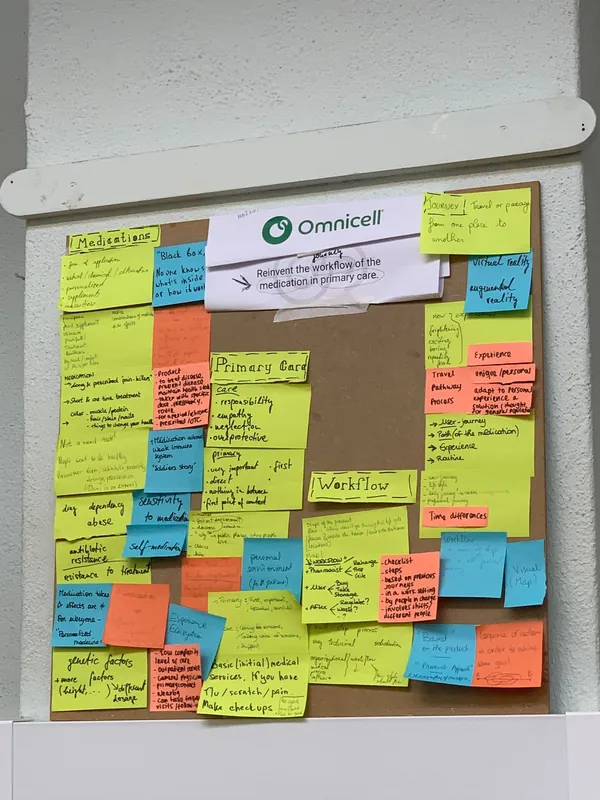
Understanding and organising treatment, not occasional forgetting, is the bigger burden. Many autonomous patients reject automatic dispensing as patronising and want help filling a box rather than someone doing it for them.
What they built
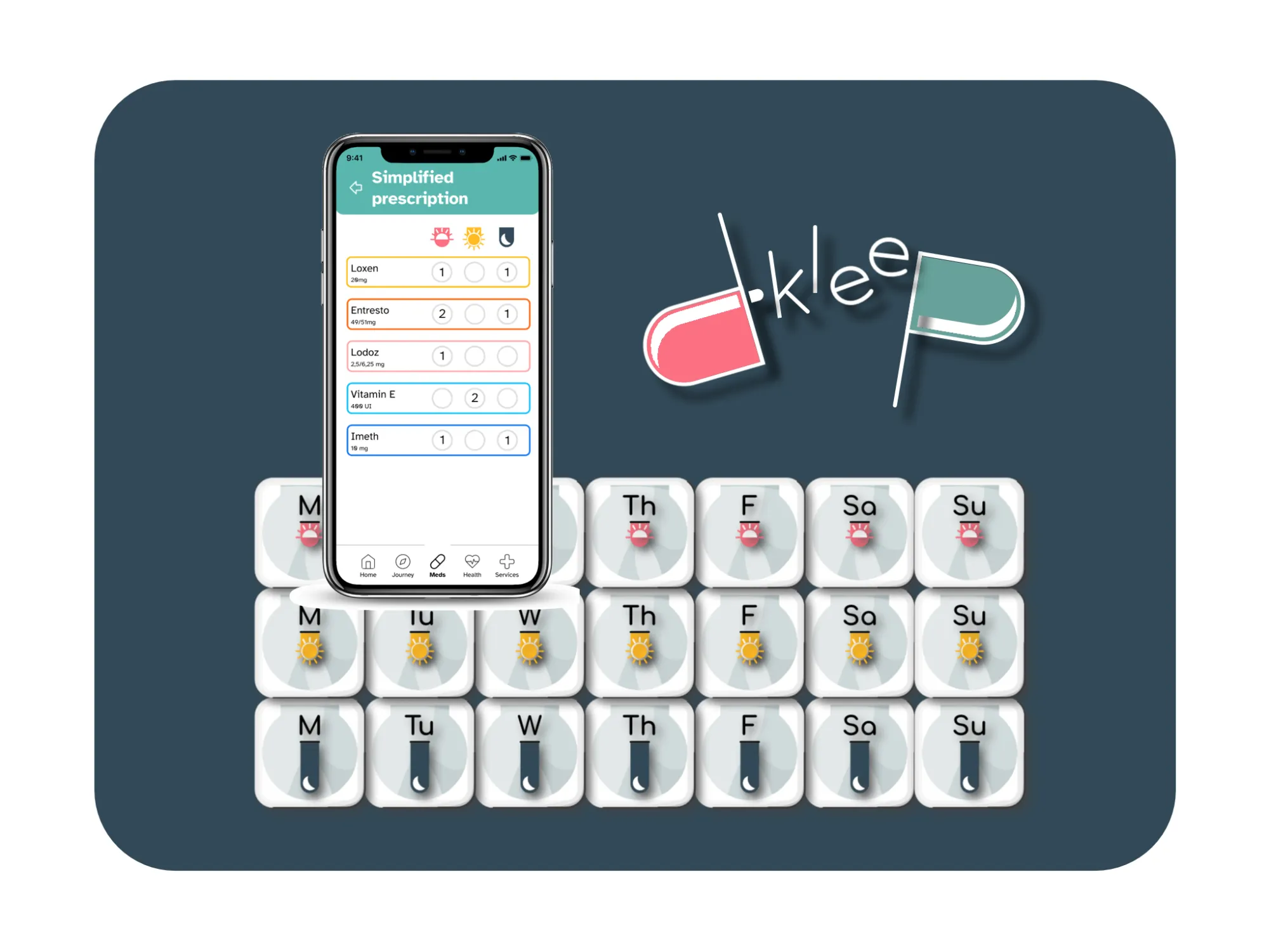
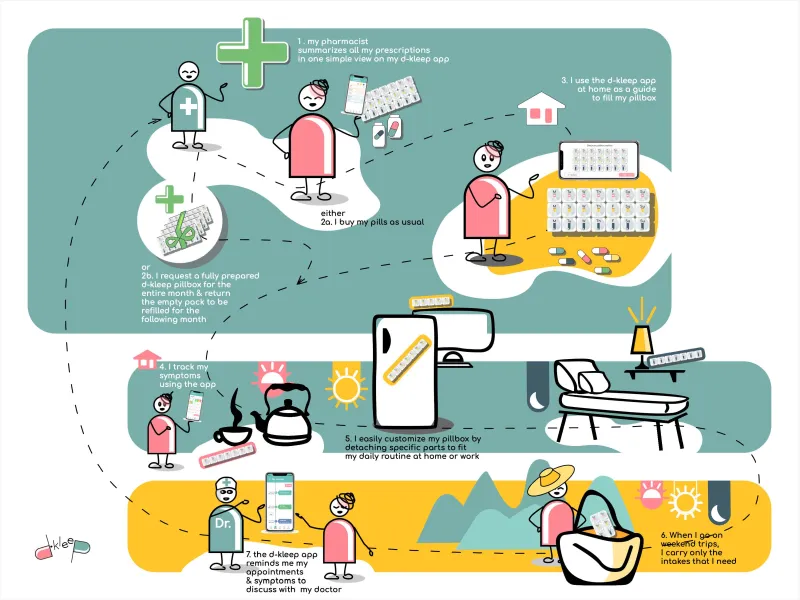
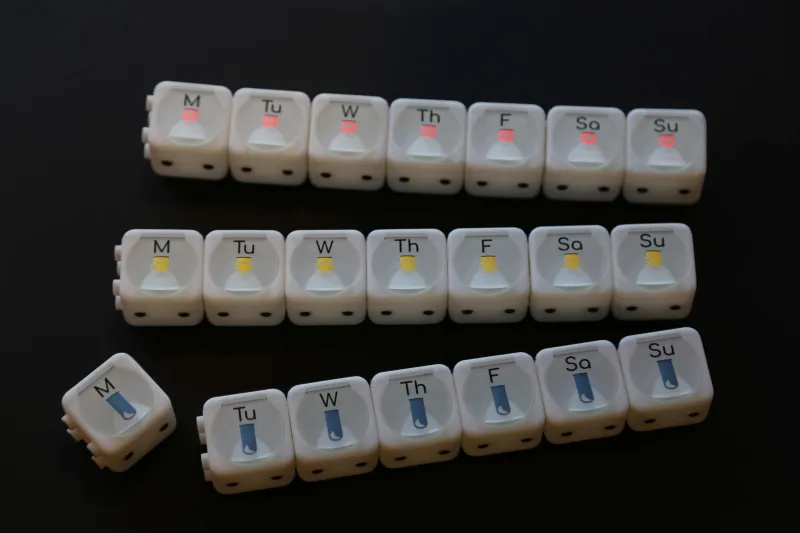
d-kleep combines a modular, clip-together pillbox, a companion app with a colour-coded filling view, appointment and symptom reminders and medicine ordering, and an optional paid pharmacy service that delivers pre-filled pillboxes.
How it evolved
- Step 1Omnicell chose an app and a low-tech product from early concepts shown at the winter presentation.
- Step 2Dispenser tests at the Pharmagora fair and with patients revealed high cost and dislike of dispensing; dropped.
- Step 3Five fill-easing prototypes led to a colour-coded stencil, then 3D-printed attach systems and a resin-printed modular box.
Results
- Field research covered 28 patients, 9 medical experts and 4 helpers, plus 7 pharmacists at Pharmagora.
- Most surveyed patients would pay 10–20 EUR a month for pre-filled doses; pharmacists estimate 20–30 EUR is needed.
Impact
The report proposes a pharmacy-based subscription, with Omnicell's automated pillbox-filling machines supporting pharmacists as volumes grow, and home nurses as a further market. No pilot is reported.
Full project text
The team’s original texts from the project page.
Revolutionizing medication management to empower autonomous polymedicated patients to control their disease, not the other way around.
Challenge
The responsibility of medication administration in inpatient settings typically relies on healthcare providers. However, in primary care, patients usually face this task by themselves, putting them at risk of medication non-adherence and poor disease control. This places a significant mental load on patients and requires management skills that not everyone possesses. Recognizing this challenge, we identified a crucial gap where autonomous patients desire to maintain control over their medication journey. Existing options either take away completely that responsibility or fail to accommodate their active lifestyles.
Solution
The d-kleep app helps patients to intuitively prepare their pillboxes thanks to a simplified and easy to understand view of their prescribed medications. With a color-coded system, users can easily place each medication in the right compartment. The app also enables a service from pharmacists to fill pillboxes for patients upon request. Additionally, patients can keep track of their symptoms and upcoming medical appointments and have their medical contacts all at one place.
With the d-kleep pillbox we want to emphasize the fact that having a chronic disease does not mean one has to give up on their active lifestyles. The modular detachable construction of this pillbox allows patients to seamlessly adapt their treatment to their routine. Moreover, ts ludic, discreet and visually appealing aspect makes the process of managing medications more enjoyable.
Impact
By adapting to patients' active lifestyles, we enable polymedicated patients to easily understand and manage their treatments with the app while being able to enjoy their lives like anyone else by having their medications handy with the modular detachable pillbox. We envision a future where patients are liberated from the constraints of complicated medication regimes. We strive for patients to autonomously navigate their medication journey, facilitating treatment adherence, disease control, and ultimately, health outcomes.
For Omnicell, this sets the opportunity to revolutionize medication management by developing solutions that supports patients’ autonomy and empower them.
Watch the team’s pitch.
Opens in a new tab – no third-party player is embedded on this page.
From the field to the prototype.
Who built it.
Klervie Pensec
Digital Marketing
Louise Noel
Architect
Emilie Graziani
Anthropologist
Emma Bedo
Engineer
Daniela Zuluaga
Medical Doctor
Pavel Zherebenkov
Biomedical Engineer